
Posted November 16, 2026

By Davis Wilson
A Comprehensive Guide to Cheating CEOs
What happens when a rockstar CEO suddenly leaves?
You might assume the answer is obvious.
Lose the person responsible for creating billions – or in Nvidia's case, trillions – of dollars of shareholder wealth, and the stock suffers.
But I went back and looked at several high-profile examples of superstar CEOs who abruptly left their companies.
The results were nothing like what I expected.
Wynn Resorts: Life After the Founder
Steve Wynn wasn’t just the CEO of Wynn Resorts.
He founded the company. His name was on the buildings. And he was one of the most important figures in the history of Las Vegas.
In January 2018, The Wall Street Journal published allegations of sexual misconduct against Wynn.
Wynn Resorts formed a special committee to investigate the allegations.
Eleven days later, Wynn resigned as CEO and chairman.
Shares had already fallen 18.6% between the publication of the allegations and his resignation.
Then something surprising happened.
The stock jumped 8.6% the first trading day after Wynn stepped down.
Three months later, it was up nearly 18% from the day he resigned.
Wynn Resorts didn't bring in some famous outsider with grand plans for transforming the company.
It promoted Matt Maddox, the company’s president who had already spent two decades at Wynn Resorts when Wynn resigned.
He knew the business he was inheriting.
And rather than tearing apart Wynn's strategy, Maddox largely continued running the company Wynn had already built.
A year later, Wynn's board said Maddox had successfully navigated the company through extraordinarily difficult circumstances, rebuilt its strategic plan and strengthened its balance sheet.
By the time Maddox announced his own departure several years later, the board credited him with rebuilding the company's culture and reestablishing Wynn as one of the world's leading luxury brands.
The founder was gone. The business kept going.
But that's not always how these stories end.
Hewlett-Packard: An $11 Billion Mistake
Mark Hurd wasn't the founder of Hewlett-Packard.
But by the time he resigned, he had become one of the most respected CEOs in corporate America.
HP had become the world's largest technology company by revenue, with businesses spanning PCs, printers, servers and corporate IT services.
Then, in August 2010, Hurd abruptly resigned after a female contractor named Jodie Fisher accused him of sexual harassment.
HP investigated and concluded that Hurd did not violate its sexual-harassment policy.
But the investigation uncovered another problem. Hurd had failed to disclose his relationship with Fisher and filed inaccurate expense reports that disguised dinners and other meetings with her as legitimate business expenses.
HP shares fell 8% the day after Hurd resigned. A year later, they were down nearly 30%.
HP replaced Hurd with former SAP CEO Leo Apotheker, who wanted to shift the company toward enterprise software.
His big move was buying British software company Autonomy for $11 billion in 2011.
It became one of the worst acquisitions in tech history.
After the deal closed, HP investigated Autonomy's accounting and alleged that the company had inflated its financial performance before the acquisition.
Just over a year after announcing the deal, HP took an $8.8 billion impairment charge. HP attributed more than $5 billion of the write-down to accounting improprieties, disclosure failures and misrepresentations discovered after the acquisition.
Apotheker was fired less than a year after becoming CEO.
In the span of just a few months, HP went from one of the best-run companies in technology to pursuing an entirely different strategy under a new CEO.
The wrong successor didn't just fail to maintain Hurd's momentum. He changed the direction of the company – and shareholders paid the price.
Intel: Betting Billions on a Comeback
Brian Krzanich abruptly resigned as Intel's CEO in 2018 after violating the company's non-fraternization policy.
What followed was one of the worst stretches in Intel's history.
For decades, Intel dominated the semiconductor industry because it designed and manufactured some of the world's most advanced chips.
Then it lost that advantage.
Manufacturing delays allowed TSMC to pull ahead, while AMD began taking market share in PCs and data centers.
Intel eventually responded with an enormous bet.
Under Pat Gelsinger, the company committed tens of billions of dollars to new factories with the goal of catching TSMC and turning Intel into a major foundry that could manufacture chips for other companies.
The strategy was incredibly expensive. Intel's foundry business lost $7 billion in 2023 alone, and the company was forced to slow some of its factory expansion plans as it tried to control costs.
At the same time, Intel missed the biggest semiconductor opportunity in decades.
The AI boom sent demand for Nvidia's GPUs soaring, while Intel remained heavily dependent on the PC and traditional server markets it had dominated for years.
By the time Gelsinger was pushed out in 2024, Intel was spending billions trying to regain its manufacturing lead while Nvidia and TSMC had become the two defining companies of the semiconductor boom.
Six years after Krzanich resigned, Intel had gone from industry leader to a company on life support.
Planned Successions Are Just as Unpredictable
You might think sudden CEO departures are uniquely dangerous because companies have no time to prepare.
But planned successions are just as unpredictable.
Take a look at data compiled by Stock Titan below:
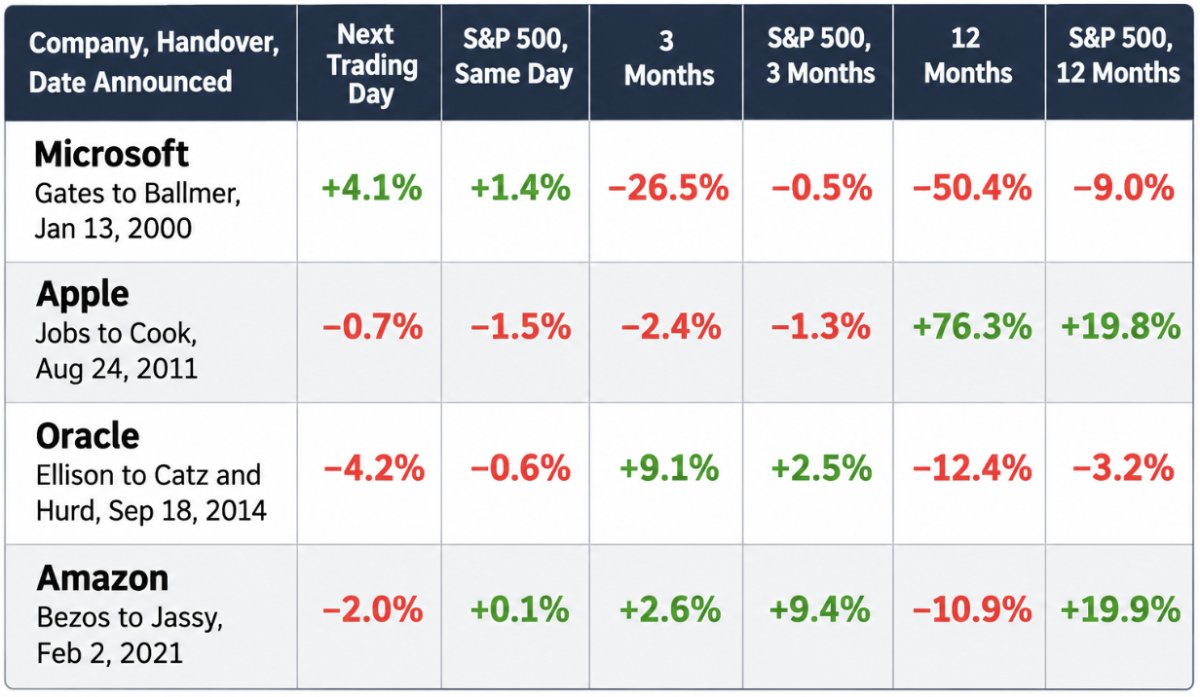
Four of the most successful founders in modern business history – Bill Gates, Steve Jobs, Larry Ellison and Jeff Bezos – carefully handed their companies to chosen successors.
The results were all over the place.
Apple soared under Tim Cook, while Microsoft lost half its value during Steve Ballmer's first year. Oracle and Amazon also underperformed the S&P 500 during the year following their transitions.
In fact, Apple was the only one of the four to outperform the market over the following 12 months.
There simply isn't a reliable formula for what happens after a legendary CEO leaves.
So What Happens With Nvidia?
The examples above went in completely different directions:
- Some companies barely missed a beat.
- Others made strategic mistakes that cost shareholders billions.
- Even carefully planned successions involving the greatest CEOs in history produced wildly different results.
What’s clear is that what happens next matters more than the departure itself.
And maybe that’s the final test of a great CEO.
Building an extraordinary company while you’re running it is one thing.
Building one that can keep winning after you’re gone is something else entirely.
For 33 years, Jensen Huang was the one making the biggest decisions at Nvidia.
Now someone else will.
Nvidia’s future will depend on whether its next leader can preserve what Jensen built while making the right decisions as the AI industry continues to evolve.
To quote former French President Charles de Gaulle:
"The graveyards are filled with indispensable men."
Jensen Huang looked indispensable to Nvidia for 33 years.
Now we’re about to find out if he really was.
Sign Up Today for Free!
Davis Wilson is attempting to make $1 Million in the stock market.
He’s starting with just $100,000.
That’s a 10X return on his money.
And the best part… He’s going to be closely documenting his journey for you to follow along – full transparency.
You can follow along by signing up for The Million Mission absolutely free.
His high risk/high reward alerts will be delivered straight to your inbox.
That means…
- You’ll know exactly what Davis is investing in throughout his journey…
- You’ll know his immediate thoughts on breaking news that can impact his (and your) portfolio…
- And you’ll get the opportunity to follow along in your own portfolio (Up to you!).
Look for these alerts on Monday, Wednesday, and Friday to start, with an “Ask Davis” email on Saturday where he’ll respond directly to reader questions and feedback.
Inside each weekday alert, you'll find timely insights and investing opportunities that Davis is targeting in his own portfolio.
These will range from AI plays to cryptocurrencies to consumer staples.
No stocks or strategies are off limits for this audacious goal.
Can he pull it off?
Enter your email below to find out.

NVDA, CBRS, BE, FNMA and Omega Wealth Circle
Posted November 14, 2026
By Davis Wilson
Jensen Is Out + My Next Move
Posted November 13, 2026
By Davis Wilson
The Jensen Huang Situation
Posted November 11, 2026
By Davis Wilson

17 Stocks. 5 Technologies. Here’s What I’d Buy.
Posted November 09, 2026
By Davis Wilson
AI Crash + My New BE Trade
Posted November 07, 2026
By Davis Wilson
