
Posted March 09, 2026

By Davis Wilson
“I Bought the IPO… Then It Collapsed”
Today I’m doing something a little different.
A reader named Don sent in a two-part email so thoughtful – and so relevant to many investors – that it deserves a full response.
Part One – a comment:
Great articles. Thank you. I have to ask about my biggest loser...
I bought Gemini Space Station (GEMI) the day it IPO'd at a midday price higher than any chart reflects, and I got hurt.
Over the weeks that followed, the price fell and I bought more to lower my average cost per share. It didn't.
After it fell even more, I bought a third time...
The good news is that my average cost per share is now under $15 and slightly below the current one year price target of Wall Street analysts.
The bad news is that it has fallen even more since my last purchase and is less than half that target price.
Don, thanks for writing in.
IPOs are big business.
But plenty of investors have lived through a similar experience, so you’re not alone here.
Part Two – two questions:
Two questions:
First, how reliable are average one-year price targets compared with analyst buy/hold/sell ratings? Which measure is more useful?
Second, regarding the strategy I used: in blackjack you double your bet after each loss until you win back the original bet, then return to the starting amount and pocket the gain (a counterintuitive approach that, I’m told, also helps facilitate your exit from the casino).
So how would you have played GEMI?
Grin and bear the loss from IPO day one, or keep buying like I did?
(Not buy GEMI at all, you say? Sure. But I didn’t have today’s chart six months ago…)
Thanks for your insights, Don
On your first question about analyst price targets vs. ratings, neither should be treated as especially reliable.
There are actually studies on this.
Research from the National Bureau of Economic Research found that analysts frequently revise price targets upward after stocks rise and downward after they fall, meaning the targets are often reactive rather than predictive.
The buy/hold/sell ratings aren’t much better.
On Wall Street, “hold” is often just a polite way of saying “this isn’t a buy,” and outright sell ratings are rare.
An analysis from Goldman Sachs looking at industry-wide recommendations found that roughly:
- ~50–55% of ratings are Buy
- ~40–45% are Hold
- 5% or fewer are Sell
The reason comes down to incentives on Wall Street.
Investment banks want companies as clients.
Those same companies are often the ones analysts are covering.
Writing a harsh sell rating about a company you hope will hire your firm for future deals isn’t exactly a great way to build that relationship.
Analysts also rely on companies for access to management teams, guidance, and conference invitations.
If you’re consistently negative, that access can disappear quickly.
None of this means every analyst is dishonest. But it does mean the system naturally discourages strong sell recommendations.
That’s why I tend to dismiss analyst targets and ratings as reliable investment signals.
Your second question is more interesting because it touches on strategy.
What you described is known as dollar cost averaging – buying more shares after the price falls in order to lower your average cost.
I actually had a very similar situation last year with Figma (FIG).
I bought shares shortly after the IPO around $100. Not long after, the stock dropped sharply.
I didn’t dollar cost average in that situation. I had a few reasons for that.
At the time, the entire software sector was starting to sell off.
In other words, it wasn’t just Figma having a bad week. The whole industry was repricing lower due to the same AI fears we’re seeing today.
Figma also came public at a very rich valuation.
When expectations are already sky high, there’s very little room for error.
That setup looks pretty similar to what’s happening with GEMI.
The company went public near the peak of the crypto cycle, and when crypto cooled off, the entire ecosystem followed.
Here are the prices of a few major crypto assets over the last six months:
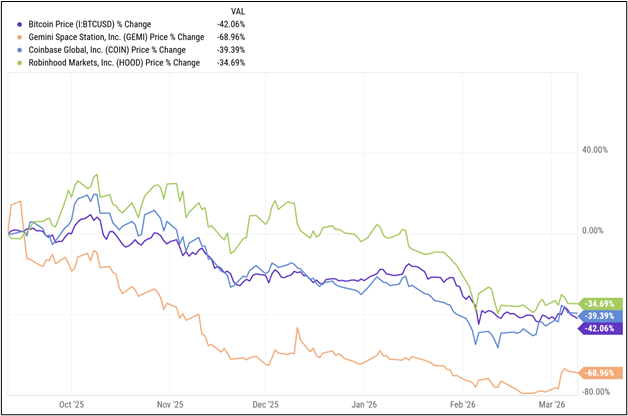
Like Figma, Gemini also came public at a rich valuation.
The company was not profitable and traded at over 20x sales – meaning the floor was a long way down.
In situations like this – where the stock is expensive plus you’ve got an industry-wide headwind – dollar cost averaging likely isn’t the right move.
Compare this with a stock like Nvidia.
That’s a company I have doubled down on.
Nvidia trades at forward valuation multiples cheaper than the broader market, yet it dominates the fastest growing industry of our lifetimes.
That’s the key distinction.
Dollar cost averaging can make sense when you’re dealing with a high-quality business that the market has temporarily mispriced.
It’s much riskier when a company is already expensively valued and the entire industry is moving against it.
So to answer your question directly: in a situation like GEMI, I likely would have taken the same approach I did with Figma and sat on my hands (and eventually sold) rather than continuing to buy more.
I’m sorry to hear about the loss. But consider it a learning experience.
I’ve had plenty of those myself. Each one has made me a better investor.
I suspect this one will do the same for you.
Keep the emails coming at AskDavis@paradigmpressgroup.com.
Sign Up Today for Free!
Davis Wilson is attempting to make $1 Million in the stock market.
He’s starting with just $100,000.
That’s a 10X return on his money.
And the best part… He’s going to be closely documenting his journey for you to follow along – full transparency.
You can follow along by signing up for The Million Mission absolutely free.
His high risk/high reward alerts will be delivered straight to your inbox.
That means…
- You’ll know exactly what Davis is investing in throughout his journey…
- You’ll know his immediate thoughts on breaking news that can impact his (and your) portfolio…
- And you’ll get the opportunity to follow along in your own portfolio (Up to you!).
Look for these alerts on Monday, Wednesday, and Friday to start, with an “Ask Davis” email on Saturday where he’ll respond directly to reader questions and feedback.
Inside each weekday alert, you'll find timely insights and investing opportunities that Davis is targeting in his own portfolio.
These will range from AI plays to cryptocurrencies to consumer staples.
No stocks or strategies are off limits for this audacious goal.
Can he pull it off?
Enter your email below to find out.

Mess With the Tesla Bulls, You Get the Horns
Posted March 07, 2026
By Davis Wilson

It's Elon's World, I'm Just Riding In It...
Posted March 06, 2026
By Davis Wilson
8 Stocks to Buy (March 4th, 2026)
Posted March 04, 2026
By Davis Wilson

US-Iran War: Your Market Playbook
Posted March 02, 2026
By Davis Wilson
Buy Alert – Wilson vs. Rickards & Sexton
Posted February 28, 2026
By Davis Wilson